The questions Ongole customers ask us most. We add to this page as new questions come up in real conversations, so it keeps growing.
“How do you decide what size system I need?”
We start from your electricity bill, not the roof or a generic package. The rule of thumb: 1 kW of panels gives roughly 4 units a day in this region, about 120 units a month. Take your average monthly units from the last several bills and divide by 120 to get a starting system size, then we round that to a size we stock and check it against your actual roof at the free site visit. Try it yourself below.
Enter the average monthly units from your last few bills. We average several months rather than one, since a single hot month or an estimated reading can throw the number off.
Estimated size:
Roof area you'd need (~100 sq ft/kW):
Estimated monthly bill savings (APCPDCL rates):
This is a starting point, not a quote. We check it against your actual roof, and against the 5 kW single-phase connection limit, at the free site visit.
“Isn't a 3 kW system just the panel price times the wattage?”
Panels are the single largest line item, but only about half the bill. For a typical 3 kW system: panels ~53% (₹98,000–1.04L), inverter ~12% (₹21,000–24,000), mounting ~10% (₹17,000–20,000), labour ~10% (₹17,000–21,000), cabling ~6% (₹10,000–13,000), earthing/MCBs ~4% (₹6,000–8,000), civil work ~3% (₹5,000–7,000), net metering coordination ~2% (₹3,000–5,000). Add it up and a 3 kW system lands at roughly ₹1.77L–2.02L, inside the ₹1.6–2.4L range quoted above. Quick mental math: roughly double whatever the panel-only price comes to, to estimate the full turnkey system cost.
This split is the same at 5 kW, only the totals move: panels scale to ~₹1.63L–1.73L, and the whole system to roughly ₹2.95L–3.37L instead of ₹1.77L–2.02L.
“My roof isn't RCC — it's tin or asbestos. Can panels even go on it?”
Yes. Tin and asbestos roofs are common around Ongole, and they can't take a system resting directly on the sheet, so we use a raised mounting structure that carries the load on the wall or the roof's support beams instead. We check this at the free site visit, since it can change the mounting cost a little from what an RCC roof needs, and we'll tell you that difference before you commit to a quote.
“What warranty comes with the system?”
There are three separate warranties, and most customers mix them up. The panel's product warranty (10-15 years) covers manufacturing defects. Its performance warranty (25 years) guarantees the panel still produces most of its original output near the end of its life. Our own workmanship warranty on the installation, typically 5 years, is separate from both, and the inverter's own lifespan (roughly 10 years) is a different clock again.
“Will panels hold up in Ongole's heat, dust and cyclone season?”
Panels are built to operate in far hotter conditions than an Ongole summer produces, so heat mostly just shaves a little off output on the hottest days, which is already factored into the numbers we quote you. Dust settles fast here, so we recommend a plain water rinse every 4-6 weeks (more often right after a dust storm), since a neglected panel loses more output to dust than to age. For wind, we size the mounting structure to your specific roof's exposure at the free site visit rather than using one generic design for every roof in town.
“When does the subsidy actually reach my account?”
The PM Surya Ghar subsidy is not an upfront discount. It is transferred directly to your own bank or loan account, never through us, after the electricity board's inspection and portal verification, typically 30-60 days after commissioning. If you've taken a loan, we recommend instructing the lender to apply the subsidy straight to the loan principal once it lands.
“Do I need to pay anything upfront if I take the SBI loan?”
No. With the SBI PM Surya Ghar loan specifically, the 10% margin isn't collected from you at signing — SBI holds that amount back and settles it only after installation is complete and their own team visits to verify it. Other lenders typically charge a higher rate too, so choosing one of them usually means a higher EMI and a higher total cost, on top of taking the full amount upfront as soon as the loan is approved. Either way, you're not asked to put in cash out of pocket to get started; we'll walk you through exactly what your specific lender's process looks like.
“Will someone explain this in Telugu, and who deals with the electricity board paperwork?”
Yes, our reps walk you through the quote, the loan paperwork and the subsidy process in Telugu, not just English; the official forms are in English because that's the electricity board's format, but nothing gets explained to you only in a language you don't use. Ongole falls under APCPDCL's Ongole Circle, and we handle the net-metering application and inspection coordination with them directly, so you're not the one following up at their office.
“How long does installation take, start to finish?”
The scheme's own official target is 30 days from application to commissioning. We tell customers a realistic 60-90 days upfront, since the timeline depends on electricity board processing rather than just our own work, and we update you the moment anything moves.
“Does my solar system keep working during a power cut?”
No, and that catches a lot of people off guard. A grid-tied system, the standard setup and what the subsidy is built around, automatically shuts off during a power cut. That's a safety feature called anti-islanding, required so your system doesn't feed electricity back into the line while the board's linemen are working on it. If you want power to keep running through outages, that needs a battery or hybrid inverter added on top, a separate cost we're happy to quote alongside the main system, but it isn't part of a standard subsidy-eligible install.
“Why does a 10 kW system need three-phase power?”
A single-phase home connection can only safely export a limited amount of power to the grid. Andhra Pradesh's APERC raised that single-phase ceiling to 5 kW in August 2026, up from 3 kW. Above that, a three-phase connection is required, this is the regulator's rule for every vendor in the state, not ours. If you don't already have three-phase power, we help you apply to the DISCOM for it as part of the process.
“Why does my bill jump so much once I cross a certain number of units?”
APCPDCL prices electricity on a telescoping scale, not a flat rate: the more you use in a month, the higher the rate on the extra units above each slab. At 0–30 units you're paying ₹1.90 a unit; cross 400 units and the units at the top are billed at ₹9.75, more than five times as much. That's the real reason a heavier summer bill jumps so sharply, you're not just using more, you're paying a steeper price for the units at the top of the ladder. It's also why solar pays back fastest for exactly the households with the highest bills: the units it replaces are the most expensive ones you were paying for.
Rate per unit (₹/kWh), APCPDCL's 2026-27 domestic telescopic slabs. Electricity duty and the fixed monthly charge aren't shown here.
“How much would a bigger or smaller system actually save me each month?”
It's not a straight line, because of the same telescoping tariff above: a bigger system knocks out more of your most expensive top-slab units first. Based on typical usage at each size and APCPDCL's own rates, here's roughly what different systems save a month:
Estimated monthly savings at typical usage for each size. Starting-point figures, not a quote; use the calculator above with your own bill for a number specific to your home.
“If I take a solar loan, what does the monthly payment actually look like?”
For a typical 3 kW system on the SBI PM Surya Ghar loan, a loan of around ₹1.4 lakh over 10 years runs to roughly ₹1,850–1,900 a month before the subsidy lands. Once the ₹78,000 subsidy is credited, usually 30-60 days after commissioning, and applied to the loan principal, that EMI typically drops to around ₹1,000–1,050 a month for the rest of the term, usually less than the electricity bill it replaces. Most households are cash-flow positive close to day one, not waiting years to feel it.
“Is solar actually worth it over the long run, in real rupee numbers?”
Panels carry a 25-year performance warranty, and a typical Ongole household recovers what it spent in 4 to 6 years after the subsidy. That leaves roughly 19-21 years of largely free electricity after payback. Over 25 years, accounting for AP's tariff climbing most years the way it usually does, total savings for a typical home commonly land in the ₹6-8 lakh range, against a net investment of ₹1.1-1.6 lakh after subsidy. We'd rather work through the honest math for your own bill at the site visit than quote a generic number here.
“What panel brands or tiers do you offer, and how does the price actually change?”
The price difference is almost entirely in the panel itself, not our labour or service, and we lay out all three tiers so you can pick with real numbers in front of you, not a sales pitch toward one option.
| Tier | Panel technology | Price | What you get |
|---|---|---|---|
| Value | Mono-PERC | ₹18–26/W | The reliable, budget-friendly starting point. A proven choice for years. |
| Standard | TOPCon | ₹20–28/W | Handles Ongole's heat a little better and loses less output over time, for a small step up in price. |
| Premium | HJT | ₹30–40/W | The best performance available today, useful when roof space is tight and every panel has to work harder. |
Every panel we quote, at every tier, is on the government's approved DCR list and eligible for the full subsidy. There's no wrong choice here, it comes down to your budget and your roof; we'll walk through all three at the free site visit.
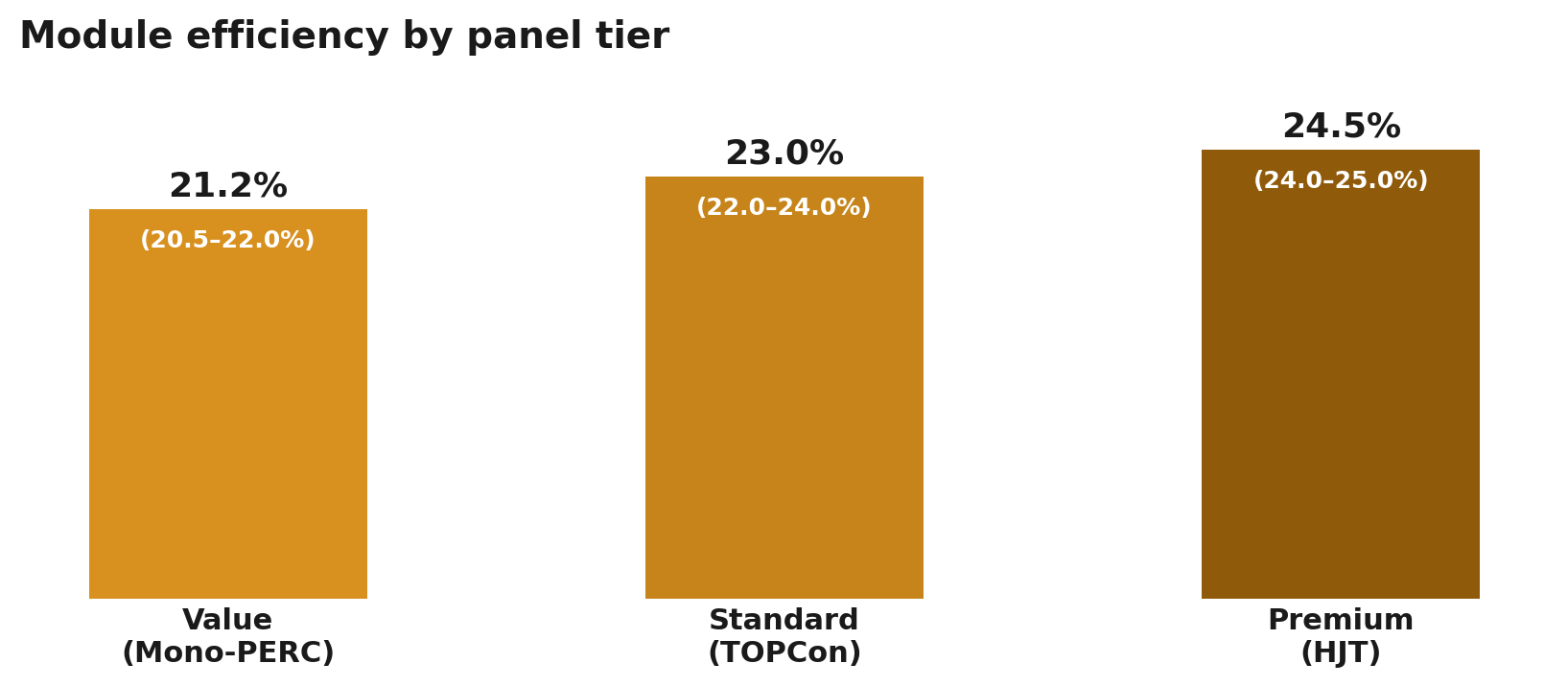
The efficiency gap is real but modest, roughly 3-4 percentage points from Value to Premium. Where it matters more in Ongole's heat is temperature performance: Premium panels lose noticeably less output on a 45°C roof than Value panels do, which is the real substance behind “handles the heat better.” Standard tier carries a 30-year performance warranty versus 25 years for Value, and Premium typically runs 25-30 years depending on the model, we'll show you the exact warranty card for whatever you pick.
“Does my roof's angle or which way it faces actually matter?”
Less than most people expect. Since almost every roof we work on in Ongole is a flat RCC terrace, not a sloped roof, we set the panel's tilt ourselves with the mounting frame, it isn't fixed by your building. Direction matters more: panels facing true south catch the most sun since we're in the Northern Hemisphere, but a roof that's off south by up to 45° is still a perfectly good install, you're only really giving up a small percentage of output. A roof that only allows due east, due west, or north-facing panels is a real trade-off worth talking through, and even then it's usually workable, just sized up slightly to compensate. We check your actual roof direction and any shading in person at the free site visit rather than guess from an address.
Have a question that isn't answered here? Ask us directly